• Re: parallel random-access machine (parallel RAM or PRAM)

    From Thomas Heger@ttt_heg@web.de to comp.lang.misc,sci.physics.relativity,sci.physics on Thu Dec 4 07:50:57 2025
    From Newsgroup: comp.lang.misc

    Am Mittwoch000003, 03.12.2025 um 08:02 schrieb Thomas 'PointedEars' Lahn:
    Thomas Heger wrote:
    Am Montag000001, 01.12.2025 um 13:23 schrieb Maciej Woźniak:
    On 12/1/2025 12:15 PM, Mild Shock wrote:
    You wrote:

    ; No, they don't, they just add one (or some)
    ; more layer on top of it.

    Techically they are not von Neuman architecture.
    Unified Memory with Multiple Tensor Cores is
    not von Neuman architecture.

    We can use von Neumann architecture
    to emulate other architectures, but as long as it
    is performed by our computers it is technically
    von Neumann's.

    Did you know, that 'von Neuman architecture'

    It really is spelled _von Neumann_, named after the Hungarian-American polymath John von Neumann. He was born (as Neumann János Lajos) into a non-observant Jewish family, and raised, in Budapest, then in the Empire of Austria-Hungary. His family name may be of German origin.

    <https://en.wikipedia.org/wiki/John_von_Neumann#Life_and_education>

    was actually invented and patented by Konrad Zuse in Germany in the early
    1930th?

    NOT true. Von Neumann's architecture "was based on the work of J. Presper Eckert and John Mauchly, inventors of ENIAC and its successor, EDVAC."


    https://de.wikipedia.org/wiki/Zuse_Z3

    Didn't you know, that 1937 was much earlier than the Eniac in 1945?


    <https://en.wikipedia.org/wiki/John_von_Neumann#Computer_science>

    ENIAC (completed in 1945) and EDVAC (completed in 1949, in operation from 1951 to 1962) were "programmable, electronic, general-purpose digital computers". They were NOT based on or copies of the Z series of computers
    as invented and built by Konrad Zuse; the first computer of that series that was fully digital was the Z5, ordered in 1950 and delivered in 1953:

    <https://en.wikipedia.org/wiki/ENIAC>
    <https://en.wikipedia.org/wiki/EDVAC> <https://en.wikipedia.org/wiki/Z5_(computer)>

    The liberators stole it from Zuse (like zillions of other patents from
    other German inventors).


    'Operation paperclip' was actually a systematical manhunt by US forces
    for German scientists.

    Also the patens were plundered, especially those from single inventors
    like Zuse.

    The US tropps actually invaded eastern Germany prior to Soviet troops,
    because they wanted to get hold of scientists from Ohrdruf in Thuringia.

    TH

    --- Synchronet 3.21a-Linux NewsLink 1.2
  • From Janis Papanagnou@janis_papanagnou+ng@hotmail.com to comp.lang.misc,sci.physics.relativity,sci.physics on Thu Dec 4 09:57:25 2025
    From Newsgroup: comp.lang.misc

    On 2025-12-04 07:50, Thomas Heger wrote:
    Am Mittwoch000003, 03.12.2025 um 08:02 schrieb Thomas 'PointedEars' Lahn:
    Thomas Heger wrote:
    Am Montag000001, 01.12.2025 um 13:23 schrieb Maciej Woźniak:
    On 12/1/2025 12:15 PM, Mild Shock wrote:
    You wrote:

      > No, they don't, they just add one (or some)
      > more layer on top of it.

    Techically they are not von Neuman architecture.
    Unified Memory with Multiple Tensor Cores is
    not von Neuman architecture.

    We can use von Neumann architecture
    to emulate other architectures, but as long as it
    is performed by our computers it is technically
    von Neumann's.

    Did you know, that 'von Neuman architecture'

    It really is spelled _von Neumann_, named after the Hungarian-American
    polymath John von Neumann.  He was born (as Neumann János Lajos) into a
    non-observant Jewish family, and raised, in Budapest, then in the
    Empire of
    Austria-Hungary.  His family name may be of German origin.

    <https://en.wikipedia.org/wiki/John_von_Neumann#Life_and_education>

    was actually invented and patented by Konrad Zuse in Germany in the
    early
    1930th?

    NOT true.  Von Neumann's architecture "was based on the work of J.
    Presper
    Eckert and John Mauchly, inventors of ENIAC and its successor, EDVAC."


    https://de.wikipedia.org/wiki/Zuse_Z3

    Didn't you know, that 1937 was much earlier than the Eniac in 1945?

    That's the date of the Z1, isn't it? - The Z3 came later, 1941.

    While concepts of modern computers where already exiting in Z1
    the first reliably running computer system was the Z3, AFAIK.
    Yes, before the ENIAC. And the plans for the Z3 were of course
    designed before their initial operation in 1941, and based on
    concepts also of its predecessors.

    But yes, history was widely misrepresented and ignoring those!
    This is an effect you can observe also in other technical areas.


    <https://en.wikipedia.org/wiki/John_von_Neumann#Computer_science>

    ENIAC (completed in 1945) and EDVAC (completed in 1949, in operation from
    1951 to 1962) were "programmable, electronic, general-purpose digital
    computers".  They were NOT based on or copies of the Z series of
    computers
    as invented and built by Konrad Zuse; the first computer of that
    series that
    was fully digital was the Z5, ordered in 1950 and delivered in 1953:

    I think that statement with the somewhat fuzzy term "fully digital"
    and its attribution to the Z5 (and not before) is not correct.

    The point is that the first computers had slight variances in their
    concepts, and if one wants to claim being the first all he has to
    do is defining the own variances as the characteristic properties
    of "a real [first] computer".

    To me it's quite obvious that the Z3 was the first running computer
    with binary logic and programmable.

    But given the severe nationalistic/patriotic struggles and battles
    who was the first who invented whatever important was invented will
    make discussions here fruitless. The facts (dates and features, and
    even construction plans) can be found online, and instead of hitting
    each others' heads with fitting "definitions" to justify one or the
    other position (which is doomed to fail) people can read the sources
    and judge themselves; there's a lot of substantial/reliable material
    available.

    <https://en.wikipedia.org/wiki/ENIAC>
    <https://en.wikipedia.org/wiki/EDVAC>
    <https://en.wikipedia.org/wiki/Z5_(computer)>

    The liberators stole it from Zuse (like zillions of other patents from
    other German inventors).


    'Operation paperclip' was actually a systematical manhunt by US forces
    for German scientists.

    Also the patens were plundered, especially those from single inventors
    like Zuse.

    The US tropps actually invaded eastern Germany prior to Soviet troops, because they wanted to get hold of scientists from Ohrdruf in Thuringia.

    TH


    (I wonder whether any of above newsgroups is relevant for that topic.)

    Janis

    --- Synchronet 3.21a-Linux NewsLink 1.2
  • From Thomas 'PointedEars' Lahn@PointedEars@web.de to comp.lang.misc,sci.physics.relativity,sci.physics on Sat Dec 6 05:30:19 2025
    From Newsgroup: comp.lang.misc

    Thomas Heger amok-crossposted over 3 newsgroups without Followup-To (!):

    Am Mittwoch000003, 03.12.2025 um 08:02 schrieb Thomas 'PointedEars' Lahn:
    Thomas Heger wrote:
    Am Montag000001, 01.12.2025 um 13:23 schrieb Maciej Woźniak:
    We can use von Neumann architecture
    to emulate other architectures, but as long as it
    is performed by our computers it is technically
    von Neumann's.

    Did you know, that 'von [Neumann] architecture'

    [correction]

    was actually invented and patented by Konrad Zuse in Germany in the early >>> 1930th?

    NOT true. Von Neumann's architecture "was based on the work of J. Presper >> Eckert and John Mauchly, inventors of ENIAC and its successor, EDVAC."

    https://de.wikipedia.org/wiki/Zuse_Z3

    Didn't you know, that 1937 was much earlier than the Eniac in 1945?

    If you had cared to read more carefully, you would have noticed that the Z3
    was a digital computer, but still *electromechanical* (it had *moving
    parts*), while the ENIAC was an *electronic* digital computer (*no moving parts*):

    <https://en.wikipedia.org/wiki/Z3_(computer)>

    [conspiracy theory]

    Get well soon.

    F'up2 comp.lang.misc again
    --
    PointedEars

    Twitter: @PointedEars2
    Please do not cc me. / Bitte keine Kopien per E-Mail.
    --- Synchronet 3.21a-Linux NewsLink 1.2
  • From Thomas 'PointedEars' Lahn@PointedEars@web.de to comp.lang.misc,sci.physics.relativity,sci.physics on Sat Dec 6 17:02:39 2025
    From Newsgroup: comp.lang.misc

    Janis Papanagnou wrote:
    On 2025-12-04 07:50, Thomas Heger wrote:
    Am Mittwoch000003, 03.12.2025 um 08:02 schrieb Thomas 'PointedEars' Lahn: >>> Thomas Heger wrote:
    Did you know, that 'von [Neumann] architecture'
    [...]
    was actually invented and patented by Konrad Zuse in Germany in the
    early 1930th?

    NOT true.  Von Neumann's architecture "was based on the work of J.
    Presper Eckert and John Mauchly, inventors of ENIAC and its successor,
    EDVAC."

    https://de.wikipedia.org/wiki/Zuse_Z3

    Didn't you know, that 1937 was much earlier than the Eniac in 1945?

    That's the date of the Z1, isn't it? - The Z3 came later, 1941.

    Twice wrong (according to the Wikipedia articles about them).

    While concepts of modern computers where already exiting in Z1
    the first reliably running computer system was the Z3, AFAIK.

    It was a *digital* computer, but NOT the first *electronic* computer.

    Yes, before the ENIAC.

    The ENIAC (completed in 1945) was (arguably) the first digital *electronic* computer:

    * Z1 (1936-1938):
    "motor-driven mechanical computer"
    <https://en.wikipedia.org/wiki/Z1_(computer)>

    * Z2 (1940):
    "electromechanical (mechanical and relay-based) digital computer"
    <https://en.wikipedia.org/wiki/Z2_(computer)>

    * Z3 (1938-1941):
    "electromechanical computer [...] the world's first working programmable,
    fully automatic digital computer"
    <https://en.wikipedia.org/wiki/Z3_(computer)>

    * Z4 (1942):
    "arguably the world's first commercial digital computer [...] Like the
    earlier Z2, it comprised a combination of mechanical memory and
    electromechanical logic."
    <https://en.wikipedia.org/wiki/Z4_(computer)>

    * ENIAC (1945):
    "first programmable, electronic, general-purpose digital computer"
    <https://en.wikipedia.org/wiki/ENIAC>

    * EDVAC (1946-1952):
    "one of the earliest electronic computers [...] binary rather than
    decimal, and was designed to be a stored-program computer".
    <https://en.wikipedia.org/wiki/EDVAC>

    * Z5 (1950-1953):
    "the first commercial built-to-order mainframe in Germany"
    <https://en.wikipedia.org/wiki/Z5_(computer)>

    And the plans for the Z3 were of course designed before their initial operation in 1941, and based on
    concepts also of its predecessors.

    But yes, history was widely misrepresented and ignoring those!

    Nonsense.

    [conspiracy theories/historical inaccuracies]

    (I wonder whether any of above newsgroups is relevant for that topic.)

    At most comp.lang.misc is regarding the computer-scientific part; but
    Thomas Heger keeps ignoring the Followup-To that I set, and keeps
    crossposting without Followup-To themselves. You are doing the latter,
    too.

    Honi soit qui mal y pense.

    F'up2 comp.lang.misc again
    --
    PointedEars

    Twitter: @PointedEars2
    Please do not cc me. / Bitte keine Kopien per E-Mail.
    --- Synchronet 3.21a-Linux NewsLink 1.2
  • From Janis Papanagnou@janis_papanagnou+ng@hotmail.com to comp.lang.misc on Sat Dec 6 18:02:33 2025
    From Newsgroup: comp.lang.misc

    On 2025-12-06 17:02, Thomas 'PointedEars' Lahn wrote:
    Janis Papanagnou wrote:
    On 2025-12-04 07:50, Thomas Heger wrote:
    Am Mittwoch000003, 03.12.2025 um 08:02 schrieb Thomas 'PointedEars' Lahn: >>>> Thomas Heger wrote:
    Did you know, that 'von [Neumann] architecture'
    [...]
    was actually invented and patented by Konrad Zuse in Germany in the
    early 1930th?

    NOT true.  Von Neumann's architecture "was based on the work of J.
    Presper Eckert and John Mauchly, inventors of ENIAC and its successor, >>>> EDVAC."

    https://de.wikipedia.org/wiki/Zuse_Z3

    Didn't you know, that 1937 was much earlier than the Eniac in 1945?

    That's the date of the Z1, isn't it? - The Z3 came later, 1941.

    Twice wrong (according to the Wikipedia articles about them).

    Wikipedia confirms both of my dates:

    "Die Z3 war einer der ersten funktionsfähigen Digitalrechner weltweit
    und wurde am 12. Mai 1941 von Konrad Zuse in seiner Werkstatt in der
    Methfesselstraße 7 in Berlin-Kreuzberg vorgestellt."

    "Die Z1 war ein mechanischer Rechner von Konrad Zuse aus dem Jahre
    1937."


    While concepts of modern computers where already exiting in Z1
    the first reliably running computer system was the Z3, AFAIK.

    It was a *digital* computer, but NOT the first *electronic* computer.

    That was not the criterion that was part of the post I was replying to.
    There was a statement about "fully digital" and about architecture not
    specific technology (gear wheels, relays, electric tubes, transistors, integrated circuits, light-based, or whatever).

    Your behavior is exactly what I was anticipating in my previous post
    where I said:

    I think that statement with the somewhat fuzzy term "fully digital"
    [...]
    The point is that the first computers had slight variances in their
    concepts, and if one wants to claim being the first all he has to
    do is defining the own variances as the characteristic properties
    of "a real [first] computer".


    And the plans for the Z3 were of course designed before their initial operation in 1941, and based on
    concepts also of its predecessors.

    But yes, history was widely misrepresented and ignoring those!

    Nonsense.

    You can read about that in Wikipedia (for example), too. You can
    find a plethora of notes on that in literature with many examples.


    It would be a gain for everyone if you'd stop your aggravating posts
    that lack both, knowledge of facts and intention to discuss topics
    in a civilized manner. But we know your character for years already.
    Because of your already from earlier times well known pathological
    sociopathic habits in your communication behavior I'll put you yet
    again in my message filter. - A stitch in time saves nine! - Bye.

    Janis

    --- Synchronet 3.21a-Linux NewsLink 1.2
  • From Thomas Heger@ttt_heg@web.de to comp.lang.misc,sci.physics.relativity,sci.physics on Sun Dec 7 10:22:00 2025
    From Newsgroup: comp.lang.misc

    Am Donnerstag000004, 04.12.2025 um 09:57 schrieb Janis Papanagnou:
    >>>
      > No, they don't, they just add one (or some)
      > more layer on top of it.

    Techically they are not von Neuman architecture.
    Unified Memory with Multiple Tensor Cores is
    not von Neuman architecture.

    We can use von Neumann architecture
    to emulate other architectures, but as long as it
    is performed by our computers it is technically
    von Neumann's.

    Did you know, that 'von Neuman architecture'

    It really is spelled _von Neumann_, named after the Hungarian-American
    polymath John von Neumann.  He was born (as Neumann János Lajos) into a >>> non-observant Jewish family, and raised, in Budapest, then in the
    Empire of
    Austria-Hungary.  His family name may be of German origin.

    <https://en.wikipedia.org/wiki/John_von_Neumann#Life_and_education>

    was actually invented and patented by Konrad Zuse in Germany in the
    early
    1930th?

    NOT true.  Von Neumann's architecture "was based on the work of J.
    Presper
    Eckert and John Mauchly, inventors of ENIAC and its successor, EDVAC."


    https://de.wikipedia.org/wiki/Zuse_Z3

    Didn't you know, that 1937 was much earlier than the Eniac in 1945?

    That's the date of the Z1, isn't it? - The Z3 came later, 1941.


    Sure, but the first computer using 'von Neumann architecture' was
    actually the Z1 of 1937.

    https://de.wikipedia.org/wiki/Von-Neumann-Architektur
    quote

    "
    Viele Ideen der Von-Neumann-Architektur waren schon 1936 von Konrad Zuse ausgearbeitet, in zwei Patentschriften 1937 dokumentiert und
    größtenteils bereits 1938 in der Z1-Maschine mechanisch realisiert
    worden. 1941 baute Konrad Zuse in Zusammenarbeit mit Helmut Schreyer mit
    der Zuse Z3 den ersten funktionsfähigen Digitalrechner der Welt. Es gilt
    aber als unwahrscheinlich, dass von Neumann die Arbeiten Zuses kannte,
    als er 1945 seine Architektur vorstellte. "

    translated by google
    "Many ideas of von Neumann's architecture had already been developed by
    Konrad Zuse in 1936, documented in two patents in 1937, and largely implemented mechanically in the Z1 machine by 1938. In 1941, Konrad
    Zuse, in collaboration with Helmut Schreyer, built the Zuse Z3, the
    world's first functional digital computer. However, it is considered
    unlikely that von Neumann was aware of Zuse's work when he presented his architecture in 1945."

    BUT: nobody gives a shit, whether or not someone knows about proir
    rights (or not).

    It is patently irrelevant, whether von Neumann knew the patents of Zuse
    (or not).

    Therefore the patents of Zuse were simply stolen and also the invention
    itself ascribed to somebody else


    While concepts of modern computers where already exiting in Z1
    the first reliably running computer system was the Z3, AFAIK.
    Yes, before the ENIAC. And the plans for the Z3 were of course
    designed before their initial operation in 1941, and based on
    concepts also of its predecessors.

    But yes, history was widely misrepresented and ignoring those!
    This is an effect you can observe also in other technical areas.


    But theft is still theft, even if it is for the sake of national pride.

    ...

    TH
    --- Synchronet 3.21a-Linux NewsLink 1.2
  • From Thomas Heger@ttt_heg@web.de to comp.lang.misc on Sun Dec 7 10:31:47 2025
    From Newsgroup: comp.lang.misc

    Am Samstag000006, 06.12.2025 um 17:02 schrieb Thomas 'PointedEars' Lahn:
    Janis Papanagnou wrote:
    On 2025-12-04 07:50, Thomas Heger wrote:
    Am Mittwoch000003, 03.12.2025 um 08:02 schrieb Thomas 'PointedEars' Lahn: >>>> Thomas Heger wrote:
    Did you know, that 'von [Neumann] architecture'
    [...]
    was actually invented and patented by Konrad Zuse in Germany in the
    early 1930th?

    NOT true.  Von Neumann's architecture "was based on the work of J.
    Presper Eckert and John Mauchly, inventors of ENIAC and its successor, >>>> EDVAC."

    https://de.wikipedia.org/wiki/Zuse_Z3

    Didn't you know, that 1937 was much earlier than the Eniac in 1945?

    That's the date of the Z1, isn't it? - The Z3 came later, 1941.

    Twice wrong (according to the Wikipedia articles about them).

    While concepts of modern computers where already exiting in Z1
    the first reliably running computer system was the Z3, AFAIK.

    It was a *digital* computer, but NOT the first *electronic* computer.

    Yes, before the ENIAC.

    The ENIAC (completed in 1945) was (arguably) the first digital *electronic* computer:


    You actually missed the point:

    that was the origin of the 'von Neumann' architekture and not the
    materials the first computers were build from.

    Actually the principle meant could be implemented by all possible means,
    which would include strings and wooden sticks.

    The point were not the computers themselves, but a theoretical concept,
    which Konrad Zuse had invented and patented in 1937.

    These patents were stolen by the allied forces- among zillions of other inventions (and occasionally the inventors, too).

    This was military plundering, because that invention was private
    property and Zuse by no means resposnsible for the deeds of the German
    Reich.


    TH

    ...
    --- Synchronet 3.21a-Linux NewsLink 1.2
  • From Thomas 'PointedEars' Lahn@PointedEars@web.de to comp.lang.misc,sci.physics.relativity,sci.physics on Sun Dec 7 10:39:47 2025
    From Newsgroup: comp.lang.misc

    Thomas Heger wrote:
    Am Donnerstag000004, 04.12.2025 um 09:57 schrieb Janis Papanagnou:
    ^^^^^^^^^^^^^^^^^^^
    Your newsreader is still broken/misconfigured. How is it possible that you have *still* not noticed yet that it produces broken attribution lines like these? (The fact aside that most of the information there is superfluous.)

    Maybe you should focus more on *your* output instead :->

    Did you know, that 'von [Neumann] architecture'
    [...]
    was actually invented and patented by Konrad Zuse in Germany in the >>>>> early 1930th?

    NOT true.  Von Neumann's architecture "was based on the work of J.
    Presper Eckert and John Mauchly, inventors of ENIAC and its successor, >>>> EDVAC."

    https://de.wikipedia.org/wiki/Zuse_Z3

    Didn't you know, that 1937 was much earlier than the Eniac in 1945?

    That's the date of the Z1, isn't it? - The Z3 came later, 1941.

    Sure, but the first computer using 'von Neumann architecture' was
    actually the Z1 of 1937.

    Irrelevant (regarding to your original argument):

    https://de.wikipedia.org/wiki/Von-Neumann-Architektur
    quote

    "
    Viele Ideen der Von-Neumann-Architektur waren schon 1936 von Konrad Zuse ausgearbeitet, in zwei Patentschriften 1937 dokumentiert und
    größtenteils bereits 1938 in der Z1-Maschine mechanisch realisiert
    worden. 1941 baute Konrad Zuse in Zusammenarbeit mit Helmut Schreyer mit
    der Zuse Z3 den ersten funktionsfähigen Digitalrechner der Welt. Es gilt aber als unwahrscheinlich, dass von Neumann die Arbeiten Zuses kannte,
    als er 1945 seine Architektur vorstellte. "

    translated by google
    "Many ideas of von Neumann's architecture had already been developed by Konrad Zuse in 1936, documented in two patents in 1937, and largely implemented mechanically in the Z1 machine by 1938. In 1941, Konrad
    Zuse, in collaboration with Helmut Schreyer, built the Zuse Z3, the
    world's first functional digital computer. However, it is considered unlikely that von Neumann was aware of Zuse's work when he presented his architecture in 1945."

    BUT: nobody gives a shit, whether or not someone knows about proir
    rights (or not).

    It is clear that *you* don't "give a shit" because this additional
    information completely destroys your argument. However, that is a fallacy.

    It is patently irrelevant, whether von Neumann knew the patents of Zuse
    (or not).

    No, that is actually the core issue here.

    But theft is still theft, even if it is for the sake of national pride.

    There was no theft. You are delusional.

    F'up2 comp.lang.misc again

    (With your newsreader [Thunderbird], you have to *manually* *add* back* the original groups in order to keep crossposting without Followup-To. So this
    is not or a newsreader bug, but *malice* on your part, perhaps out of
    delusions of grandeur. JFYI: Your postings are *NOT* *that* *important*
    that you have to blast them to 3 newsgroups *continuously*, only one of
    which has to do with the topic of the discussion.)
    --
    PointedEars

    Twitter: @PointedEars2
    Please do not cc me. / Bitte keine Kopien per E-Mail.
    --- Synchronet 3.21a-Linux NewsLink 1.2
  • From Thomas 'PointedEars' Lahn@PointedEars@web.de to comp.lang.misc,sci.physics.relativity,sci.physics on Sun Dec 7 10:46:38 2025
    From Newsgroup: comp.lang.misc

    Thomas Heger wrote:
    Am Donnerstag000004, 04.12.2025 um 09:57 schrieb Janis Papanagnou:
    ^^^^^^^^^^^^^^^^^^^
    Your newsreader is still broken/misconfigured. How is it possible that you have *still* not noticed yet that it produces broken attribution lines like these? (The fact aside that most of the information there is superfluous.)

    Maybe you should focus more on *your* output instead :->

    Did you know, that 'von [Neumann] architecture'
    [...]
    was actually invented and patented by Konrad Zuse in Germany in the >>>>> early 1930th?

    NOT true.  Von Neumann's architecture "was based on the work of J.
    Presper Eckert and John Mauchly, inventors of ENIAC and its successor, >>>> EDVAC."

    https://de.wikipedia.org/wiki/Zuse_Z3

    Didn't you know, that 1937 was much earlier than the Eniac in 1945?

    That's the date of the Z1, isn't it? - The Z3 came later, 1941.

    Sure, but the first computer using 'von Neumann architecture' was
    actually the Z1 of 1937.

    Irrelevant (regarding to your original argument):

    https://de.wikipedia.org/wiki/Von-Neumann-Architektur
    quote

    "
    Viele Ideen der Von-Neumann-Architektur waren schon 1936 von Konrad Zuse ausgearbeitet, in zwei Patentschriften 1937 dokumentiert und
    größtenteils bereits 1938 in der Z1-Maschine mechanisch realisiert
    worden. 1941 baute Konrad Zuse in Zusammenarbeit mit Helmut Schreyer mit
    der Zuse Z3 den ersten funktionsfähigen Digitalrechner der Welt. Es gilt aber als unwahrscheinlich, dass von Neumann die Arbeiten Zuses kannte,
    als er 1945 seine Architektur vorstellte. "

    translated by google
    "Many ideas of von Neumann's architecture had already been developed by Konrad Zuse in 1936, documented in two patents in 1937, and largely implemented mechanically in the Z1 machine by 1938. In 1941, Konrad
    Zuse, in collaboration with Helmut Schreyer, built the Zuse Z3, the
    world's first functional digital computer. However, it is considered unlikely that von Neumann was aware of Zuse's work when he presented his architecture in 1945."

    BUT: nobody gives a shit, whether or not someone knows about proir
    rights (or not).

    It is clear that *you* don't "give a shit" because this additional
    information completely destroys your argument. However, that is a fallacy.

    It is patently irrelevant, whether von Neumann knew the patents of Zuse
    (or not).

    No, that is actually the core issue here.

    But theft is still theft, even if it is for the sake of national pride.

    There was no theft. You are delusional.

    F'up2 comp.lang.misc again

    (With your newsreader [Thunderbird], you have to *manually* *add* back* the original groups in order to keep crossposting without Followup-To. So this
    is not a newsreader bug, but *malice* on your part, perhaps out of
    delusions of grandeur. JFYI: Your postings are *NOT* *that* *important*
    that you have to blast them to 3 newsgroups *continuously*, only one of
    which has to do with the topic of the discussion.)
    --
    PointedEars

    Twitter: @PointedEars2
    Please do not cc me. / Bitte keine Kopien per E-Mail.
    --- Synchronet 3.21a-Linux NewsLink 1.2
  • From Janis Papanagnou@janis_papanagnou+ng@hotmail.com to comp.lang.misc,sci.physics.relativity,sci.physics on Sun Dec 7 11:42:40 2025
    From Newsgroup: comp.lang.misc

    On 2025-12-07 10:22, Thomas Heger wrote:
    Am Donnerstag000004, 04.12.2025 um 09:57 schrieb Janis Papanagnou:
    [...]
    That's the date of the Z1, isn't it? - The Z3 came later, 1941.

    Sure, but the first computer using 'von Neumann architecture' was
    actually the Z1 of 1937.

    Well, yes. At least mostly. That's why I've written upthread that
    the concepts from the earlier Z1 were reused in Z3.

    My point was just when the first _working_ digital and programmable
    computer was invented. - And in my humble opinion that was the Z3!

    A bit care must be taken though with your quoted Wiki paragraph:
    "Viele Ideen der Von-Neumann-Architektur [...]"
    It's - at least by this statement - open what was already existing
    and what property was new in von Neumann's concepts. - Here's where
    the arguments may become heated; remember my statement about: "just
    define the properties of the own invention, and every other (prior)
    system may not match by some detail" (sort of).

    The sometimes used technology reasoning is certainly not convincing
    if we're speaking about the architecture principles and concepts.

    [...]

    It is patently irrelevant, whether von Neumann knew the patents of Zuse
    (or not).
    Yes, basically also true. - But mind that a "Deutsches Reichspatent"
    isn't valid in the USA. You need a separate application in the USA.

    What's also true is that even a "Deutsches Reichspatent" would make
    it possible to make a correct historic attribution of that invention
    (if only 'ex post').


    Therefore the patents of Zuse were simply stolen and also the invention itself ascribed to somebody else

    Given that they assume that von Neumann did not know about Zuse's
    invention I think that the word "stolen" is a too harsh valuation.

    I agree concerning the existing (and common) ascription mischief.


    [...]

    But yes, history was widely misrepresented and ignoring those!
    This is an effect you can observe also in other technical areas.

    But theft is still theft, even if it is for the sake of national pride.

    Yes, but consider also what I wrote above.

    Janis

    --- Synchronet 3.21a-Linux NewsLink 1.2
  • From Thomas 'PointedEars' Lahn@PointedEars@web.de to comp.lang.misc on Sun Dec 7 12:59:20 2025
    From Newsgroup: comp.lang.misc

    Janis Papanagnou wrote:
    On 2025-12-06 17:02, Thomas 'PointedEars' Lahn wrote:
    Janis Papanagnou wrote:
    On 2025-12-04 07:50, Thomas Heger wrote:
    Am Mittwoch000003, 03.12.2025 um 08:02 schrieb Thomas 'PointedEars' Lahn: >>>>> Thomas Heger wrote:
    Did you know, that 'von [Neumann] architecture'
    [...]
    was actually invented and patented by Konrad Zuse in Germany in the >>>>>> early 1930th?

    NOT true.  Von Neumann's architecture "was based on the work of J.
    Presper Eckert and John Mauchly, inventors of ENIAC and its successor, >>>>> EDVAC."

    https://de.wikipedia.org/wiki/Zuse_Z3

    Didn't you know, that 1937 was much earlier than the Eniac in 1945?

    That's the date of the Z1, isn't it? - The Z3 came later, 1941.

    Twice wrong (according to the Wikipedia articles about them).

    Wikipedia confirms both of my dates:

    "Die Z3 war einer der ersten funktionsfähigen Digitalrechner weltweit
    und wurde am 12. Mai 1941 von Konrad Zuse in seiner Werkstatt in der
    Methfesselstraße 7 in Berlin-Kreuzberg vorgestellt."

    "Die Z1 war ein mechanischer Rechner von Konrad Zuse aus dem Jahre
    1937."

    It is more complicated than that: It took several years from design to
    the completion of each of these computers. Read the list and follow the references that I gave.

    While concepts of modern computers where already exiting in Z1
    the first reliably running computer system was the Z3, AFAIK.

    It was a *digital* computer, but NOT the first *electronic* computer.

    That was not the criterion that was part of the post I was replying to.

    Yes, it was. The claim was that the "von Neumann architecture" that ENIAC
    was based on was based on the Z3, ignoring that ENIAC and the Z3 did not
    even use the same technology: While both were digital computers, one of them (the Z3) was an *electromechanical* computer and the other (ENIAC) was an *electronic* one.

    The two computers also differed in operation (the original Z3 was never put into everyday operation, and was destroyed during an Allied bombardment of Berlin in 1943; while ENIAC was in continuous operation from 1945 to 1955)
    and capabilities (the Z3 lacked conditional branching, so was not strictly Turing-complete; ENIAC was).

    Apples and oranges.
    --
    PointedEars

    Twitter: @PointedEars2
    Please do not cc me. / Bitte keine Kopien per E-Mail.
    --- Synchronet 3.21a-Linux NewsLink 1.2
  • From Thomas 'PointedEars' Lahn@PointedEars@web.de to comp.lang.misc on Sun Dec 7 13:00:59 2025
    From Newsgroup: comp.lang.misc


    Thomas Heger wrote:
    vvvvvvvvvvvvvvvvv
    Am Samstag000006, 06.12.2025 um 17:02 schrieb Thomas 'PointedEars' Lahn:
    ^^^^^^^^^^^^^^^^^
    Still broken.

    Janis Papanagnou wrote:
    While concepts of modern computers where already exiting in Z1
    the first reliably running computer system was the Z3, AFAIK.

    It was a *digital* computer, but NOT the first *electronic* computer.

    Yes, before the ENIAC.

    The ENIAC (completed in 1945) was (arguably) the first digital *electronic* >> computer:

    You actually missed the point:

    that was the origin of the 'von Neumann' architekture

    No.
    --
    PointedEars

    Twitter: @PointedEars2
    Please do not cc me. / Bitte keine Kopien per E-Mail.
    --- Synchronet 3.21a-Linux NewsLink 1.2
  • From Michael S@already5chosen@yahoo.com to comp.lang.misc,sci.physics.relativity,sci.physics on Sun Dec 7 16:26:41 2025
    From Newsgroup: comp.lang.misc

    On Sun, 7 Dec 2025 11:42:40 +0100
    Janis Papanagnou <janis_papanagnou+ng@hotmail.com> wrote:

    On 2025-12-07 10:22, Thomas Heger wrote:
    Am Donnerstag000004, 04.12.2025 um 09:57 schrieb Janis Papanagnou:
    [...]
    That's the date of the Z1, isn't it? - The Z3 came later, 1941.

    Sure, but the first computer using 'von Neumann architecture' was
    actually the Z1 of 1937.

    Well, yes. At least mostly. That's why I've written upthread that
    the concepts from the earlier Z1 were reused in Z3.


    I'd say, no. Neither Z1 nor Z3 are von Neumann architecture computers.
    And it has nothing to them being either electronic or mechanical.
    The key element (==distinguishing feature) of von Neumann architecture,
    at least in modern (say, of last 60-65 years) meaning of the term
    is that program store and data memory reside in the same space. Which
    leads to possibility of self-modifying code. Which led to Von
    Neumann's claim that index register is unnecessary for array
    processing. Which is undeniable mathematical truth and serious
    engineering mistake at the same time.

    --- Synchronet 3.21a-Linux NewsLink 1.2
  • From Janis Papanagnou@janis_papanagnou+ng@hotmail.com to comp.lang.misc,sci.physics.relativity,sci.physics on Mon Dec 8 04:25:32 2025
    From Newsgroup: comp.lang.misc

    On 2025-12-07 15:26, Michael S wrote:
    On Sun, 7 Dec 2025 11:42:40 +0100
    Janis Papanagnou <janis_papanagnou+ng@hotmail.com> wrote:

    On 2025-12-07 10:22, Thomas Heger wrote:
    Am Donnerstag000004, 04.12.2025 um 09:57 schrieb Janis Papanagnou:
    [...]
    That's the date of the Z1, isn't it? - The Z3 came later, 1941.

    Sure, but the first computer using 'von Neumann architecture' was
    actually the Z1 of 1937.

    Well, yes. At least mostly. That's why I've written upthread that
    the concepts from the earlier Z1 were reused in Z3.


    I'd say, no. Neither Z1 nor Z3 are von Neumann architecture computers.

    Right. - Considering all properties, von Neumann's computers had a
    von Neumann's architecture.

    And it has nothing to them being either electronic or mechanical.

    (This was just one common example by some to attest its innovation
    and being "the first".)

    The key element (==distinguishing feature) of von Neumann architecture,
    at least in modern (say, of last 60-65 years) meaning of the term
    is that program store and data memory reside in the same space.

    Yes. But is that crucial for a programmable computer? Is that the
    functionally necessary or important element? - I'd clearly say no!


    Which leads to possibility of self-modifying code.

    And that specifically is neither a necessity for a "[universally]
    programmable computer" - IMO the historic noteworthy key property! -
    nor an example how systems sensibly should be (or are) programmed.
    We avoid in practice exactly that property (modulo virus-developers,
    maybe, and similar corner cases).

    Which led to Von
    Neumann's claim that index register is unnecessary for array
    processing. Which is undeniable mathematical truth and serious
    engineering mistake at the same time.

    Yes.


    An inherent logical problem lies also in the argumentation chain
    we commonly see...
    "Contemporary computers are "basically" all characterized by
    von Neumann's architectures."
    "Von Neumann's computers are defined by ...property list..."
    "Von Neumann was the inventor of [contemporary] computers."
    (I assume you notice the dodge.)

    I really don't want to engage in such discussions[*] but I think we
    should at least understand the mechanics behind that. The interests
    and the rhetoric/argumentation moves used to establish such agendas.

    Janis

    [*] We know how the inventions have been and (partly) still are
    attributed, we see the various areas, and the actors' agendas and
    interests, and we observe that also on various levels (countries,
    competing companies, partners, plain sponges, gender status, etc.);
    there's countless examples of historic mis-attributions.

    --- Synchronet 3.21a-Linux NewsLink 1.2
  • From Thomas Heger@ttt_heg@web.de to comp.lang.misc on Mon Dec 8 08:10:56 2025
    From Newsgroup: comp.lang.misc

    Am Sonntag000007, 07.12.2025 um 10:46 schrieb Thomas 'PointedEars' Lahn:
    Thomas Heger wrote:
    Am Donnerstag000004, 04.12.2025 um 09:57 schrieb Janis Papanagnou:
    ^^^^^^^^^^^^^^^^^^^
    Your newsreader is still broken/misconfigured. How is it possible that you have *still* not noticed yet that it produces broken attribution lines like these? (The fact aside that most of the information there is superfluous.)

    This behavior was quoted by me, but apparently stemmed from 'Janis Papanagnou'.

    Not sure, if that guy was the source, but don't care, anyhow.


    Did you know, that 'von [Neumann] architecture'
    [...]
    was actually invented and patented by Konrad Zuse in Germany in the >>>>>> early 1930th?

    NOT true.  Von Neumann's architecture "was based on the work of J.
    Presper Eckert and John Mauchly, inventors of ENIAC and its successor, >>>>> EDVAC."

    https://de.wikipedia.org/wiki/Zuse_Z3

    Didn't you know, that 1937 was much earlier than the Eniac in 1945?

    That's the date of the Z1, isn't it? - The Z3 came later, 1941.

    Sure, but the first computer using 'von Neumann architecture' was
    actually the Z1 of 1937.

    Irrelevant (regarding to your original argument):

    My 'original argument' was that US 'liberators' not only stole the
    patent for Zuse's invention, but also the fame and gave it to someone else.


    ...


    TH
    --- Synchronet 3.21a-Linux NewsLink 1.2
  • From Thomas Heger@ttt_heg@web.de to comp.lang.misc,sci.physics.relativity,sci.physics on Mon Dec 8 08:21:45 2025
    From Newsgroup: comp.lang.misc

    Am Sonntag000007, 07.12.2025 um 11:42 schrieb Janis Papanagnou:
    On 2025-12-07 10:22, Thomas Heger wrote:
    Am Donnerstag000004, 04.12.2025 um 09:57 schrieb Janis Papanagnou:
    [...]
    That's the date of the Z1, isn't it? - The Z3 came later, 1941.

    Sure, but the first computer using 'von Neumann architecture' was
    actually the Z1 of 1937.

    Well, yes. At least mostly. That's why I've written upthread that
    the concepts from the earlier Z1 were reused in Z3.

    My point was just when the first _working_ digital and programmable
    computer was invented. - And in my humble opinion that was the Z3!

    A bit care must be taken though with your quoted Wiki paragraph:
    "Viele Ideen der Von-Neumann-Architektur [...]"
    It's - at least by this statement - open what was already existing
    and what property was new in von Neumann's concepts. - Here's where
    the arguments may become heated; remember my statement about: "just
    define the properties of the own invention, and every other (prior)
    system may not match by some detail" (sort of).

    The sometimes used technology reasoning is certainly not convincing
    if we're speaking about the architecture principles and concepts.

    [...]

    It is patently irrelevant, whether von Neumann knew the patents of
    Zuse (or not).
    Yes, basically also true. - But mind that a "Deutsches Reichspatent"
    isn't valid in the USA. You need a separate application in the USA.


    An invention needs to be new.

    Otherwise it is not an invention.

    At least this is the main principle upon which patents are granted in
    Germany.

    The US-patent office is based upon a slightly different principle.

    The main principle is that of a 'claim', which is occupied by some company.

    This difference can also be found in the difference between US copyright
    and German 'Urheberrecht'.

    German Urheberrecht is not based on any kind of registration, but automatically granted to the creator of some sort of art.

    And patents can not be registered in Germany, if the invention isn't
    new, whether 'prior art' is registered, patended or just published in a magazine.

    This is a huge difference, because no formal registration of prior art
    is necessary.

    In contrast the US patent is mainly a claim and 'occupied' by whatever
    dirty means necessary.

    ...


    TH
    --- Synchronet 3.21a-Linux NewsLink 1.2
  • From Thomas 'PointedEars' Lahn@PointedEars@web.de to comp.lang.misc on Mon Dec 8 08:44:18 2025
    From Newsgroup: comp.lang.misc

    Thomas Heger wrote:
    Am Sonntag000007, 07.12.2025 um 10:46 schrieb Thomas 'PointedEars' Lahn:
    ^^^^^^^^^^^^^^^^^
    Thomas Heger wrote:
    Am Donnerstag000004, 04.12.2025 um 09:57 schrieb Janis Papanagnou:
    ^^^^^^^^^^^^^^^^^^^
    Your newsreader is still broken/misconfigured. How is it possible that you >> have *still* not noticed yet that it produces broken attribution lines like >> these? (The fact aside that most of the information there is superfluous.)

    This behavior was quoted by me, but apparently stemmed from 'Janis Papanagnou'.

    Not sure, if that guy was the source, but don't care, anyhow.

    [Now in their and my native language, German, as apparently I am not getting through to them in English:]

    Du merkst nichts mehr, oder? Es ist *Dein* Newsreader, der diese kaputten Einleitungszeilen "Am Sonntag000007, ..." erzeugt. Das kannst Du leicht
    sehen, wenn Du Deine Postings *vor* dem Absenden einmal Korrektur liest (das solltest Du ohnehin immer tun, dann schreibst Du auch weniger Mist :->).

    Reparier das endlich (Erweiterung für Einleitungszeilen konfigurieren oder deaktivieren)!

    Sure, but the first computer using 'von Neumann architecture' was
    actually the Z1 of 1937.

    Irrelevant (regarding to your original argument):

    My 'original argument' was that US 'liberators' not only stole the
    patent for Zuse's invention, but also the fame and gave it to someone else.

    Which is pure fantasy. Why is it beyond your imagination that people having approximately the same knowledge can arrive at similar or even the same
    ideas independently?
    --
    PointedEars

    Twitter: @PointedEars2
    Please do not cc me. / Bitte keine Kopien per E-Mail.
    --- Synchronet 3.21a-Linux NewsLink 1.2
  • From Janis Papanagnou@janis_papanagnou+ng@hotmail.com to comp.lang.misc on Mon Dec 8 08:49:52 2025
    From Newsgroup: comp.lang.misc

    On 2025-12-08 08:10, Thomas Heger wrote:
    Am Sonntag000007, 07.12.2025 um 10:46 schrieb Thomas 'PointedEars' Lahn:
    Thomas Heger wrote:
    Am Donnerstag000004, 04.12.2025 um 09:57 schrieb Janis Papanagnou:
       ^^^^^^^^^^^^^^^^^^^
    Your newsreader is still broken/misconfigured.  How is it possible
    that you
    have *still* not noticed yet that it produces broken attribution lines
    like
    these?  (The fact aside that most of the information there is
    superfluous.)

    This behavior was quoted by me, but apparently stemmed from 'Janis Papanagnou'.

    Not as far as I can tell. - This part I saw already with you first
    posts on that topic in the newsgroup where I read it:

    | Am Mittwoch000003, 03.12.2025 um 08:02 schrieb Thomas 'PointedEars' Lahn:
    | > Thomas Heger wrote:
    | >> Am Montag000001, 01.12.2025 um 13:23 schrieb Maciej Woźniak:
    | >>> On 12/1/2025 12:15 PM, Mild Shock wrote:

    It's always added (explicitly by you, or implicitly by your system)
    from your posts obviously. The effect is visible before I joined the
    thread.


    Not sure, if that guy was the source, but don't care, anyhow.

    I also don't care. Just noting it; because - as I think attributions
    of historic inventions should not be wrong - also wrong attributions
    of such posting quirks should not blame the wrong person. ;-)

    Janis

    --- Synchronet 3.21a-Linux NewsLink 1.2
  • From Thomas 'PointedEars' Lahn@PointedEars@web.de to comp.lang.misc,sci.physics.relativity,sci.physics on Mon Dec 8 08:51:14 2025
    From Newsgroup: comp.lang.misc

    Janis Papanagnou wrote:
    On 2025-12-07 15:26, Michael S wrote:
    On Sun, 7 Dec 2025 11:42:40 +0100
    Janis Papanagnou <janis_papanagnou+ng@hotmail.com> wrote:
    On 2025-12-07 10:22, Thomas Heger wrote:
    Am Donnerstag000004, 04.12.2025 um 09:57 schrieb Janis Papanagnou:
    [...]
    That's the date of the Z1, isn't it? - The Z3 came later, 1941.

    Sure, but the first computer using 'von Neumann architecture' was
    actually the Z1 of 1937.

    Well, yes. At least mostly. That's why I've written upthread that
    the concepts from the earlier Z1 were reused in Z3.

    I'd say, no. Neither Z1 nor Z3 are von Neumann architecture computers.

    Right. - Considering all properties, von Neumann's computers had a
    von Neumann's architecture.

    *facepalm*

    Once again:

    | Von Neumann consulted for the Army's Ballistic Research Laboratory, most
    | notably on the ENIAC project,[274] as a member of its Scientific Advisory
    | Committee.[275] Although the single-memory, stored-program architecture is
    | commonly called von Neumann architecture, the architecture was based on
    | the work of J. Presper Eckert and John Mauchly, inventors of ENIAC and its
    | successor, EDVAC. While consulting for the EDVAC project at the University
    | of Pennsylvania, von Neumann wrote an incomplete "First Draft of a Report
    | on the EDVAC". The paper, whose premature distribution nullified the
    | patent claims of Eckert and Mauchly, described a computer, that stored
    | both its data and its program in the same address space, unlike the
    | earliest computers which stored their programs separately on paper tape or
    | plugboards. This architecture became the basis of most modern computer
    | designs.

    <https://en.wikipedia.org/wiki/John_von_Neumann#Computer_science>

    FOLLOWUP-TO comp.lang.misc! (for the single-celled ones)
    --
    PointedEars

    Twitter: @PointedEars2
    Please do not cc me. / Bitte keine Kopien per E-Mail.
    --- Synchronet 3.21a-Linux NewsLink 1.2
  • From Janis Papanagnou@janis_papanagnou+ng@hotmail.com to comp.lang.misc,sci.physics.relativity,sci.physics on Mon Dec 8 09:06:46 2025
    From Newsgroup: comp.lang.misc

    On 2025-12-08 08:21, Thomas Heger wrote:

    An invention needs to be new. Otherwise it is not an invention.

    Not only new, but also not being something considered trivial or
    otherwise not "worthy" of being a patent.

    At least this is the main principle upon which patents are granted in Germany.

    In the German patent history we can observe that even marvellous
    inventions have not been granted a patent because the officials
    could neither understand nor see the actual or potential future
    relevance and usefulness.

    (My point was the [non-existing] reach of a German patent in the
    USA.)


    The US-patent office is based upon a slightly different principle.

    The main principle is that of a 'claim', which is occupied by some company.

    With a granted patent in Germany you can exploit the commercial
    gains yourself or with companies licensing the patents during
    the first years after getting the patent.

    Besides the commercial aspects the primary point of a patent can
    probably be derived from the meaning of its name; Latin "patere",
    to be open [for the society], to provide gain for mankind.

    (Semantics in popular recognition may have changed given the
    prevalence of commercial thinking worldwide.)

    [snip digressions to 'US copyright' and 'Urheberrecht']

    Janis

    --- Synchronet 3.21a-Linux NewsLink 1.2
  • From Michael S@already5chosen@yahoo.com to comp.lang.misc,sci.physics.relativity,sci.physics on Mon Dec 8 13:58:25 2025
    From Newsgroup: comp.lang.misc

    On Mon, 8 Dec 2025 04:25:32 +0100
    Janis Papanagnou <janis_papanagnou+ng@hotmail.com> wrote:

    On 2025-12-07 15:26, Michael S wrote:
    On Sun, 7 Dec 2025 11:42:40 +0100
    Janis Papanagnou <janis_papanagnou+ng@hotmail.com> wrote:

    On 2025-12-07 10:22, Thomas Heger wrote:
    Am Donnerstag000004, 04.12.2025 um 09:57 schrieb Janis
    Papanagnou:
    [...]
    That's the date of the Z1, isn't it? - The Z3 came later, 1941.

    Sure, but the first computer using 'von Neumann architecture' was
    actually the Z1 of 1937.

    Well, yes. At least mostly. That's why I've written upthread that
    the concepts from the earlier Z1 were reused in Z3.


    I'd say, no. Neither Z1 nor Z3 are von Neumann architecture
    computers.

    Right. - Considering all properties, von Neumann's computers had a
    von Neumann's architecture.

    And it has nothing to them being either electronic or mechanical.

    (This was just one common example by some to attest its innovation
    and being "the first".)

    The key element (==distinguishing feature) of von Neumann
    architecture, at least in modern (say, of last 60-65 years) meaning
    of the term is that program store and data memory reside in the
    same space.

    Yes. But is that crucial for a programmable computer? Is that the functionally necessary or important element? - I'd clearly say no!


    Is it not particularly important for programmable computer.
    When I design MCU-based systems, my MCUs are physically able to do von
    Neumann (i.e. to run program from RAM) but I don't utilize this
    property, treating them as if they were Harvard.
    The biggest and fastest growing computing business of recent years
    is based on programmable computers (GPGPUs, TPUs, NPUs) that can not
    modify theier own programs.
    However, computers with which we interact most, so called
    general-purpose computers, from smartphones to servers, are very
    heavily dependent on being von Neumann.


    Which leads to possibility of self-modifying code.

    And that specifically is neither a necessity for a "[universally] programmable computer" - IMO the historic noteworthy key property! -
    nor an example how systems sensibly should be (or are) programmed.
    We avoid in practice exactly that property (modulo virus-developers,
    maybe, and similar corner cases).


    You are thinking about SMC at small. Think about it at larger scale.
    Level one: OS loads application. It's rare that it just blindly
    copies the image from disk. More often it modifies it to fit at
    particular address. Esp. so today, with ASLR considered must.
    Level two: JIT. For good or for bad, a cornerstone of modern web.

    Which led to Von
    Neumann's claim that index register is unnecessary for array
    processing. Which is undeniable mathematical truth and serious
    engineering mistake at the same time.

    Yes.


    An inherent logical problem lies also in the argumentation chain
    we commonly see...
    "Contemporary computers are "basically" all characterized by
    von Neumann's architectures."
    "Von Neumann's computers are defined by ...property list..."
    "Von Neumann was the inventor of [contemporary] computers."
    (I assume you notice the dodge.)

    I really don't want to engage in such discussions[*] but I think we
    should at least understand the mechanics behind that. The interests
    and the rhetoric/argumentation moves used to establish such agendas.


    I don't find it interesting.

    Janis

    [*] We know how the inventions have been and (partly) still are
    attributed, we see the various areas, and the actors' agendas and
    interests, and we observe that also on various levels (countries,
    competing companies, partners, plain sponges, gender status, etc.);
    there's countless examples of historic mis-attributions.


    --- Synchronet 3.21a-Linux NewsLink 1.2
  • From Thomas Heger@ttt_heg@web.de to comp.lang.misc,sci.physics.relativity,sci.physics on Tue Dec 9 09:15:47 2025
    From Newsgroup: comp.lang.misc

    Am Montag000008, 08.12.2025 um 04:25 schrieb Janis Papanagnou:
    On 2025-12-07 15:26, Michael S wrote:
    On Sun, 7 Dec 2025 11:42:40 +0100
    Janis Papanagnou <janis_papanagnou+ng@hotmail.com> wrote:

    On 2025-12-07 10:22, Thomas Heger wrote:
    Am Donnerstag000004, 04.12.2025 um 09:57 schrieb Janis Papanagnou:
    [...]
    That's the date of the Z1, isn't it? - The Z3 came later, 1941.

    Sure, but the first computer using 'von Neumann architecture' was
    actually the Z1 of 1937.

    Well, yes. At least mostly. That's why I've written upthread that
    the concepts from the earlier Z1 were reused in Z3.


    An inherent logical problem lies also in the argumentation chain
    we commonly see...
    "Contemporary computers are "basically" all characterized by
     von Neumann's architectures."
    "Von Neumann's computers are defined by ...property list..."
    "Von Neumann was the inventor of [contemporary] computers."
    (I assume you notice the dodge.)

    I really don't want to engage in such discussions[*] but I think we
    should at least understand the mechanics behind that. The interests
    and the rhetoric/argumentation moves used to establish such agendas.

    Janis

    [*] We know how the inventions have been and (partly) still are
    attributed, we see the various areas, and the actors' agendas and
    interests, and we observe that also on various levels (countries,
    competing companies, partners, plain sponges, gender status, etc.);
    there's countless examples of historic mis-attributions.


    It's a HUGE problem, because tons of almost every kind of art, music, invention, writing and so forth was not created by the famed person, who allegedly created it.

    Usually you have an 'alpha', who didn't do anything at all (sing, paint,
    write or invent) and a (or occasionally many) 'beta' who did all the
    difficult work for a small amount of money.

    Now the 'alpha' gets the product of a certain beta from an agent (let's
    call that 'Q') and declares it to be the own work.

    Other scumbags clap their hands and write euphoric articles.

    The work is copied and sold millions of times and everybody is happy.

    (Well, not quite everybody is happy. But that little inconvenience could
    be accepted.)


    TH

    --- Synchronet 3.21a-Linux NewsLink 1.2
  • From Thomas Heger@ttt_heg@web.de to comp.lang.misc,sci.physics.relativity,sci.physics on Tue Dec 9 09:19:05 2025
    From Newsgroup: comp.lang.misc

    Am Montag000008, 08.12.2025 um 09:06 schrieb Janis Papanagnou:
    On 2025-12-08 08:21, Thomas Heger wrote:

    An invention needs to be new. Otherwise it is not an invention.

    Not only new, but also not being something considered trivial or
    otherwise not "worthy" of being a patent.

    At least this is the main principle upon which patents are granted in
    Germany.

    In the German patent history we can observe that even marvellous
    inventions have not been granted a patent because the officials
    could neither understand nor see the actual or potential future
    relevance and usefulness.

    (My point was the [non-existing] reach of a German patent in the

    Sure, but what is already invented in Germany ins't new in the USA neither.

    'New' means really new.

    If something is already published anywhere, the 'newness' is missing.

    ...

    TH
    --- Synchronet 3.21a-Linux NewsLink 1.2
  • From The Starmaker@starmaker@ix.netcom.com to comp.lang.misc,sci.physics.relativity,sci.physics on Tue Dec 9 11:43:18 2025
    From Newsgroup: comp.lang.misc

    On Mon, 8 Dec 2025 09:06:46 +0100, Janis Papanagnou <janis_papanagnou+ng@hotmail.com> wrote:

    On 2025-12-08 08:21, Thomas Heger wrote:

    An invention needs to be new. Otherwise it is not an invention.

    Not only new, but also not being something considered trivial or
    otherwise not "worthy" of being a patent.

    At least this is the main principle upon which patents are granted in
    Germany.

    In the German patent history we can observe that even marvellous
    inventions have not been granted a patent because the officials
    could neither understand nor see the actual or potential future
    relevance and usefulness.


    Albert Einstein worked at a patent office and even decided WHO gets
    the patent. Albert Einstein was bribred to give the patent to the guy
    who bribed him.

    https://groups.google.com/g/sci.physics.relativity/c/WhZcPHah3Dc/m/QaT6MFBIAAAJ


    Did you see the boat they gave him for it?


    Albert Einstein told his friends to create FAKE patents!
    (at least they got a patent on something)

    https://blog.nuclearsecrecy.com/2014/05/16/szilards-chain-reaction/


    Only an Einstein can think of fake patents.
    (he approves it himself)


    (My point was the [non-existing] reach of a German patent in the
    USA.)


    The US-patent office is based upon a slightly different principle.

    The main principle is that of a 'claim', which is occupied by some company.

    With a granted patent in Germany you can exploit the commercial
    gains yourself or with companies licensing the patents during
    the first years after getting the patent.

    Besides the commercial aspects the primary point of a patent can
    probably be derived from the meaning of its name; Latin "patere",
    to be open [for the society], to provide gain for mankind.

    (Semantics in popular recognition may have changed given the
    prevalence of commercial thinking worldwide.)

    [snip digressions to 'US copyright' and 'Urheberrecht']

    Janis
    --
    The Starmaker -- To question the unquestionable, ask the unaskable,
    to think the unthinkable, mention the unmentionable, say the unsayable,
    and challenge the unchallengeable.
    --- Synchronet 3.21a-Linux NewsLink 1.2
  • From Thomas Heger@ttt_heg@web.de to comp.lang.misc,sci.physics.relativity,sci.physics on Wed Dec 10 08:19:04 2025
    From Newsgroup: comp.lang.misc

    Am Dienstag000009, 09.12.2025 um 20:43 schrieb The Starmaker:
    On Mon, 8 Dec 2025 09:06:46 +0100, Janis Papanagnou <janis_papanagnou+ng@hotmail.com> wrote:

    On 2025-12-08 08:21, Thomas Heger wrote:

    An invention needs to be new. Otherwise it is not an invention.

    Not only new, but also not being something considered trivial or
    otherwise not "worthy" of being a patent.

    At least this is the main principle upon which patents are granted in
    Germany.

    In the German patent history we can observe that even marvellous
    inventions have not been granted a patent because the officials
    could neither understand nor see the actual or potential future
    relevance and usefulness.


    Albert Einstein worked at a patent office and even decided WHO gets
    the patent. Albert Einstein was bribred to give the patent to the guy
    who bribed him.

    https://groups.google.com/g/sci.physics.relativity/c/WhZcPHah3Dc/m/QaT6MFBIAAAJ


    Did you see the boat they gave him for it?


    Albert Einstein told his friends to create FAKE patents!
    (at least they got a patent on something)

    https://blog.nuclearsecrecy.com/2014/05/16/szilards-chain-reaction/


    Only an Einstein can think of fake patents.
    (he approves it himself)


    Einstein and Szillard patented a device, which is commonly called
    'Einstein's fridge'.

    But that device has only one known use as part of a fast breeding reactor.

    And a group of students who wanted to replicate the device found out,
    that it didn't cool.

    So, a plausible guess would be:

    the 'fridge' was actually meant to become a part of a fast breeding
    reactor, but named 'fridge' to hide this fact.


    But that would lead to a very unpleasant conclusion:

    to patent a part of a fast breeding reactor would require the existence
    of a fast breeding reactor in the first place.

    And that would require the need of Plutonium, because that's the stuff
    which thoese reactors 'breed'.

    And as Plutonium is among the most toxic substances on the planet, it
    requires good reason to want Plutonium.

    That could actually be the existence of atomic bombs already in the late 1920th/early 1930th in Germany. And that would suggest, that all stories related to the creation of the bomb were fake, too.

    That would mean, that the so called 'Manhattan project' didn't invent
    the bomb, but had other objectives (like e.g. placing a 'secrecy gag'
    upon theoretical physics).

    Also chilling would be, that in such a scenario the Germans were in
    possesion of atomic bombs already in the late 1920th.

    TH


    --- Synchronet 3.21a-Linux NewsLink 1.2
  • From Thomas 'PointedEars' Lahn@PointedEars@web.de to comp.lang.misc,sci.physics.relativity,sci.physics on Wed Dec 10 09:56:45 2025
    From Newsgroup: comp.lang.misc

    [posted & mailed; to be read with a fixed-width font]

    Thomas Heger amok-crossposted across 3 newsgroups without Followup-To:
    Am Dienstag000009, 09.12.2025 um 20:43 schrieb The Starmaker:
    ,'.
    ,' `.
    ,'__ __'.
    : :
    : :
    : :
    : :
    When are you going to fix this?

    [...]
    And a group of students who wanted to replicate the device found out,
    that it didn't cool.

    So, a plausible guess would be:

    No, that would not be plausible. Ockham's razor suggests instead that those students -- if the story is even true -- made a mistake *because* they were just *students* and thus inexperienced. But, of course, this simple thought never occurs first to a *diseased* mind:

    the [Einstein] 'fridge' was actually meant to become a part of a fast breeding reactor, but named 'fridge' to hide this fact.

    But that would lead to a very unpleasant conclusion:

    to patent a part of a fast breeding reactor would require the existence
    of a fast breeding reactor in the first place.

    <https://en.wikipedia.org/wiki/Paranoia> <https://de.wikipedia.org/wiki/Paranoia>

    [developing a conspiracy theory while going down the rabbit hole
    they digged for themselves]

    You should see a psychologist, maybe even a psychiatrist.

    Get well soon.
    --
    PointedEars

    Twitter: @PointedEars2
    Please do not cc me. / Bitte keine Kopien per E-Mail.
    --- Synchronet 3.21a-Linux NewsLink 1.2
  • From The Starmaker@starmaker@ix.netcom.com to comp.lang.misc,sci.physics.relativity,sci.physics on Wed Dec 10 10:01:36 2025
    From Newsgroup: comp.lang.misc

    On Wed, 10 Dec 2025 08:19:04 +0100, Thomas Heger <ttt_heg@web.de>
    wrote:

    Am Dienstag000009, 09.12.2025 um 20:43 schrieb The Starmaker:
    On Mon, 8 Dec 2025 09:06:46 +0100, Janis Papanagnou
    <janis_papanagnou+ng@hotmail.com> wrote:

    On 2025-12-08 08:21, Thomas Heger wrote:

    An invention needs to be new. Otherwise it is not an invention.

    Not only new, but also not being something considered trivial or
    otherwise not "worthy" of being a patent.

    At least this is the main principle upon which patents are granted in
    Germany.

    In the German patent history we can observe that even marvellous
    inventions have not been granted a patent because the officials
    could neither understand nor see the actual or potential future
    relevance and usefulness.


    Albert Einstein worked at a patent office and even decided WHO gets
    the patent. Albert Einstein was bribred to give the patent to the guy
    who bribed him.

    https://groups.google.com/g/sci.physics.relativity/c/WhZcPHah3Dc/m/QaT6MFBIAAAJ


    Did you see the boat they gave him for it?


    Albert Einstein told his friends to create FAKE patents!
    (at least they got a patent on something)

    https://blog.nuclearsecrecy.com/2014/05/16/szilards-chain-reaction/


    Only an Einstein can think of fake patents.
    (he approves it himself)


    Einstein and Szillard patented a device, which is commonly called >'Einstein's fridge'.

    But that device has only one known use as part of a fast breeding reactor.

    And a group of students who wanted to replicate the device found out,
    that it didn't cool.

    So, a plausible guess would be:

    the 'fridge' was actually meant to become a part of a fast breeding
    reactor, but named 'fridge' to hide this fact.


    But that would lead to a very unpleasant conclusion:

    to patent a part of a fast breeding reactor would require the existence
    of a fast breeding reactor in the first place.

    And that would require the need of Plutonium, because that's the stuff
    which thoese reactors 'breed'.

    And as Plutonium is among the most toxic substances on the planet, it >requires good reason to want Plutonium.

    That could actually be the existence of atomic bombs already in the late >1920th/early 1930th in Germany. And that would suggest, that all stories >related to the creation of the bomb were fake, too.

    That would mean, that the so called 'Manhattan project' didn't invent
    the bomb, but had other objectives (like e.g. placing a 'secrecy gag'
    upon theoretical physics).

    Also chilling would be, that in such a scenario the Germans were in >possesion of atomic bombs already in the late 1920th.

    TH


    I lost count how many times I posted here...

    that which you call "a fast breeding reactor"

    is what you see in the diagram here..

    https://www.google.com/search?q=fast+breeding+reactor.&oq=fast+breeding+reactor


    In other words, Albert Einstein himself took out a patent on a fast
    breeding reactor, but called it something else:

    When Albert Einstein first took out a patent on his/the first nuclear
    reactor system in 1927


    Here is what a Reactor looks like today:

    https://twitter.com/Starmaker111/status/1148280696122699778/photo/1


    and here is a cut-out out of both:

    https://twitter.com/Starmaker111/status/1148279328121090048/photo/1


    Now, I don't know if he stole the idea from Germany...

    But, this is Albert Einstein's patent on a "fast breeding reactor"!

    https://patentimages.storage.googleapis.com/53/e9/74/2cde176701fab8/US1781541.pdf


    none are so blind...
    --
    The Starmaker -- To question the unquestionable, ask the unaskable,
    to think the unthinkable, mention the unmentionable, say the unsayable,
    and challenge the unchallengeable.
    --- Synchronet 3.21a-Linux NewsLink 1.2
  • From Thomas Heger@ttt_heg@web.de to comp.lang.misc,sci.physics.relativity,sci.physics on Thu Dec 11 09:02:56 2025
    From Newsgroup: comp.lang.misc

    Am Mittwoch000010, 10.12.2025 um 19:01 schrieb The Starmaker:
    On Wed, 10 Dec 2025 08:19:04 +0100, Thomas Heger <ttt_heg@web.de>
    wrote:

    Am Dienstag000009, 09.12.2025 um 20:43 schrieb The Starmaker:
    On Mon, 8 Dec 2025 09:06:46 +0100, Janis Papanagnou
    <janis_papanagnou+ng@hotmail.com> wrote:

    On 2025-12-08 08:21, Thomas Heger wrote:

    An invention needs to be new. Otherwise it is not an invention.

    Not only new, but also not being something considered trivial or
    otherwise not "worthy" of being a patent.

    At least this is the main principle upon which patents are granted in >>>>> Germany.

    In the German patent history we can observe that even marvellous
    inventions have not been granted a patent because the officials
    could neither understand nor see the actual or potential future
    relevance and usefulness.


    Albert Einstein worked at a patent office and even decided WHO gets
    the patent. Albert Einstein was bribred to give the patent to the guy
    who bribed him.

    https://groups.google.com/g/sci.physics.relativity/c/WhZcPHah3Dc/m/QaT6MFBIAAAJ


    Did you see the boat they gave him for it?


    Albert Einstein told his friends to create FAKE patents!
    (at least they got a patent on something)

    https://blog.nuclearsecrecy.com/2014/05/16/szilards-chain-reaction/


    Only an Einstein can think of fake patents.
    (he approves it himself)


    Einstein and Szillard patented a device, which is commonly called
    'Einstein's fridge'.

    But that device has only one known use as part of a fast breeding reactor. >>
    And a group of students who wanted to replicate the device found out,
    that it didn't cool.

    So, a plausible guess would be:

    the 'fridge' was actually meant to become a part of a fast breeding
    reactor, but named 'fridge' to hide this fact.


    But that would lead to a very unpleasant conclusion:

    to patent a part of a fast breeding reactor would require the existence
    of a fast breeding reactor in the first place.

    And that would require the need of Plutonium, because that's the stuff
    which thoese reactors 'breed'.

    And as Plutonium is among the most toxic substances on the planet, it
    requires good reason to want Plutonium.

    That could actually be the existence of atomic bombs already in the late
    1920th/early 1930th in Germany. And that would suggest, that all stories
    related to the creation of the bomb were fake, too.

    That would mean, that the so called 'Manhattan project' didn't invent
    the bomb, but had other objectives (like e.g. placing a 'secrecy gag'
    upon theoretical physics).

    Also chilling would be, that in such a scenario the Germans were in
    possesion of atomic bombs already in the late 1920th.

    TH


    I lost count how many times I posted here...

    that which you call "a fast breeding reactor"

    is what you see in the diagram here..

    https://www.google.com/search?q=fast+breeding+reactor.&oq=fast+breeding+reactor


    This is a good paper about the subject:

    https://fissilematerials.org/library/rr08.pdf

    Quote:

    "
    Fast Breeder Reactor Programs: History and Status
    Overview: The Rise and Fall of Plutonium Breeder Reactors
    Frank von Hippel
    1
    The possibility of a plutonium‑fueled nuclear reactor that could produce more fuel than it consumed (a “breeder reactor”) was first raised during World War II in the United States by scientists in the atomic bomb program."

    But this was seemingly a lie, because if the first fast breeding
    reactors were invented and built in Los Alamos in WWII, then why and how
    could Einstein invent and patent a part of that reactor already in 1930
    in Berlin?

    ...


    TH
    --- Synchronet 3.21a-Linux NewsLink 1.2
  • From The Starmaker@starmaker@ix.netcom.com to comp.lang.misc,sci.physics.relativity,sci.physics on Thu Dec 11 08:48:12 2025
    From Newsgroup: comp.lang.misc

    On Thu, 11 Dec 2025 09:02:56 +0100, Thomas Heger <ttt_heg@web.de>
    wrote:

    Am Mittwoch000010, 10.12.2025 um 19:01 schrieb The Starmaker:
    On Wed, 10 Dec 2025 08:19:04 +0100, Thomas Heger <ttt_heg@web.de>
    wrote:

    Am Dienstag000009, 09.12.2025 um 20:43 schrieb The Starmaker:
    On Mon, 8 Dec 2025 09:06:46 +0100, Janis Papanagnou
    <janis_papanagnou+ng@hotmail.com> wrote:

    On 2025-12-08 08:21, Thomas Heger wrote:

    An invention needs to be new. Otherwise it is not an invention.

    Not only new, but also not being something considered trivial or
    otherwise not "worthy" of being a patent.

    At least this is the main principle upon which patents are granted in >>>>>> Germany.

    In the German patent history we can observe that even marvellous
    inventions have not been granted a patent because the officials
    could neither understand nor see the actual or potential future
    relevance and usefulness.


    Albert Einstein worked at a patent office and even decided WHO gets
    the patent. Albert Einstein was bribred to give the patent to the guy
    who bribed him.

    https://groups.google.com/g/sci.physics.relativity/c/WhZcPHah3Dc/m/QaT6MFBIAAAJ


    Did you see the boat they gave him for it?


    Albert Einstein told his friends to create FAKE patents!
    (at least they got a patent on something)

    https://blog.nuclearsecrecy.com/2014/05/16/szilards-chain-reaction/


    Only an Einstein can think of fake patents.
    (he approves it himself)


    Einstein and Szillard patented a device, which is commonly called
    'Einstein's fridge'.

    But that device has only one known use as part of a fast breeding reactor. >>>
    And a group of students who wanted to replicate the device found out,
    that it didn't cool.

    So, a plausible guess would be:

    the 'fridge' was actually meant to become a part of a fast breeding
    reactor, but named 'fridge' to hide this fact.


    But that would lead to a very unpleasant conclusion:

    to patent a part of a fast breeding reactor would require the existence
    of a fast breeding reactor in the first place.

    And that would require the need of Plutonium, because that's the stuff
    which thoese reactors 'breed'.

    And as Plutonium is among the most toxic substances on the planet, it
    requires good reason to want Plutonium.

    That could actually be the existence of atomic bombs already in the late >>> 1920th/early 1930th in Germany. And that would suggest, that all stories >>> related to the creation of the bomb were fake, too.

    That would mean, that the so called 'Manhattan project' didn't invent
    the bomb, but had other objectives (like e.g. placing a 'secrecy gag'
    upon theoretical physics).

    Also chilling would be, that in such a scenario the Germans were in
    possesion of atomic bombs already in the late 1920th.

    TH


    I lost count how many times I posted here...

    that which you call "a fast breeding reactor"

    is what you see in the diagram here..

    https://www.google.com/search?q=fast+breeding+reactor.&oq=fast+breeding+reactor


    This is a good paper about the subject:

    https://fissilematerials.org/library/rr08.pdf

    Quote:

    "
    Fast Breeder Reactor Programs: History and Status
    Overview: The Rise and Fall of Plutonium Breeder Reactors
    Frank von Hippel
    1
    The possibility of a plutonium?fueled nuclear reactor that could produce >more fuel than it consumed (a breeder reactor) was first raised during >World War II in the United States by scientists in the atomic bomb program."

    But this was seemingly a lie, because if the first fast breeding
    reactors were invented and built in Los Alamos in WWII, then why and how >could Einstein invent and patent a part of that reactor already in 1930
    in Berlin?

    ...


    TH


    Albert Einstein and his gang of friends were busy building an atomic
    bomb before the Manhattan Project...

    here is FERMI, Enrico patent in 1935 https://onlineonly.christies.com/s/fine-printed-books-manuscripts-including-americana/patent-method-producing-nuclear-reactions-139/270604?ldp_breadcrumb=back&sc_lang=zh


    Some recent work by E.Fermi and L. Szilard, which has been com-

    municated to me in manuscript, leads me to expect that the element
    uran-

    ium may be turned into a new and important source of energy in the im-

    mediate future.

    b) to speed up the experimental work,which is at present being car-

    ried on within the limits of the budgets of University laboratories

    https://hypertextbook.com/eworld/einstein/#first


    The "University laboratories" is in fact the Manhattan Project.


    They got the money, right?

    They finish the experiment...

    they dropped the bomb.


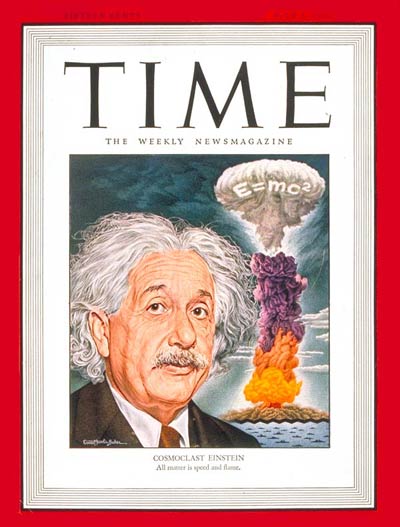
    https://content.time.com/time/magazine/archive/covers/1946/1101460701_400.jpg --
    The Starmaker -- To question the unquestionable, ask the unaskable,
    to think the unthinkable, mention the unmentionable, say the unsayable,
    and challenge the unchallengeable.
    --- Synchronet 3.21a-Linux NewsLink 1.2
  • From Thomas 'PointedEars' Lahn@PointedEars@web.de to comp.lang.misc,sci.physics.relativity,sci.physics on Fri Dec 12 01:58:37 2025
    From Newsgroup: comp.lang.misc

    Thomas Heger wrote:
    [...] if the first fast breeding reactors were invented and built in
    Los Alamos in WWII, then why and how could Einstein invent and patent
    a part of that reactor already in 1930 in Berlin?

    Very simple: He hasn't. He designed, together with Szilard, _a
    refrigerator_, in 1926. Szilárd, not Einstein, patented it in the U.S. in 1930.

    <https://en.wikipedia.org/wiki/Einstein_refrigerator>

    You just went from a self-built slippery slope down a rabbit hole, guided by your paranoia. (Is your mind still sane enough for you to accept your mistake?)
    --
    PointedEars

    Twitter: @PointedEars2
    Please do not cc me. / Bitte keine Kopien per E-Mail.
    --- Synchronet 3.21a-Linux NewsLink 1.2
  • From The Starmaker@starmaker@ix.netcom.com to comp.lang.misc,sci.physics.relativity,sci.physics,sci.math on Thu Dec 11 20:45:30 2025
    From Newsgroup: comp.lang.misc

    On Fri, 12 Dec 2025 01:58:37 +0100, Thomas 'PointedEars' Lahn <PointedEars@web.de> wrote:

    Thomas Heger wrote:
    [...] if the first fast breeding reactors were invented and built in
    Los Alamos in WWII, then why and how could Einstein invent and patent
    a part of that reactor already in 1930 in Berlin?

    Very simple: He hasn't. He designed, together with Szilard, _a >refrigerator_, in 1926. Szilrd, not Einstein, patented it in the U.S. in 1930.

    <https://en.wikipedia.org/wiki/Einstein_refrigerator>

    You just went from a self-built slippery slope down a rabbit hole, guided by >your paranoia. (Is your mind still sane enough for you to accept your mistake?)


    That link ' Thomas 'PointedEars' Lahn' posted is a FRAUDULENT webpage.

    https://en.wikipedia.org/wiki/Einstein_refrigerator

    Anyone can see the fruad by looking at the picture on the right:
    "Einstein's and Szilrd's patent application"

    https://en.wikipedia.org/wiki/Einstein_refrigerator#/media/File:Einstein_Refrigerator.png

    They inserted a fruad hand drawn calligraphy fonts that reads at the
    bottom
    "Einstein Refridegerator"
    (patent number, date and signatures are also fraud) is all hand drawn calligraphy fonts ans script writing.

    Here is the REAL Einstein patent on Google Patent Website. (that
    doesn't contain the fruad)

    https://patentimages.storage.googleapis.com/53/e9/74/2cde176701fab8/US1781541.pdf


    You cannot trust an African BushPig with 'PointedEars'.


    Thomas 'PointedEars' Lahn is an 'off-the cuff' ' guy who
    lacks ...knowledge.

    I don't know how he manages to get out of bed everyday...

    i bet he doesn't know how the can-opener works.
    --
    The Starmaker -- To question the unquestionable, ask the unaskable,
    to think the unthinkable, mention the unmentionable, say the unsayable,
    and challenge the unchallengeable.
    --- Synchronet 3.21a-Linux NewsLink 1.2
  • From The Starmaker@starmaker@ix.netcom.com to comp.lang.misc,sci.physics.relativity,sci.physics,sci.math on Thu Dec 11 23:07:33 2025
    From Newsgroup: comp.lang.misc

    On Thu, 11 Dec 2025 20:45:30 -0800, The Starmaker
    <starmaker@ix.netcom.com> wrote:

    On Fri, 12 Dec 2025 01:58:37 +0100, Thomas 'PointedEars' Lahn ><PointedEars@web.de> wrote:

    Thomas Heger wrote:
    [...] if the first fast breeding reactors were invented and built in
    Los Alamos in WWII, then why and how could Einstein invent and patent
    a part of that reactor already in 1930 in Berlin?

    Very simple: He hasn't. He designed, together with Szilard, _a >>refrigerator_, in 1926. Szilrd, not Einstein, patented it in the U.S. in 1930.

    <https://en.wikipedia.org/wiki/Einstein_refrigerator>

    You just went from a self-built slippery slope down a rabbit hole, guided by >>your paranoia. (Is your mind still sane enough for you to accept your mistake?)


    That link ' Thomas 'PointedEars' Lahn' posted is a FRAUDULENT webpage.

    https://en.wikipedia.org/wiki/Einstein_refrigerator

    Anyone can see the fruad by looking at the picture on the right:
    "Einstein's and Szilrd's patent application"

    https://en.wikipedia.org/wiki/Einstein_refrigerator#/media/File:Einstein_Refrigerator.png

    They inserted a fruad hand drawn calligraphy fonts that reads at the
    bottom
    "Einstein Refridegerator"
    (patent number, date and signatures are also fraud) is all hand drawn >calligraphy fonts ans script writing.

    Here is the REAL Einstein patent on Google Patent Website. (that
    doesn't contain the fruad)

    https://patentimages.storage.googleapis.com/53/e9/74/2cde176701fab8/US1781541.pdf


    You cannot trust an African BushPig with 'PointedEars'.


    Thomas 'PointedEars' Lahn is an 'off-the cuff' ' guy who
    lacks ...knowledge.

    I don't know how he manages to get out of bed everyday...

    i bet he doesn't know how the can-opener works.

    Also, you have to watch out for Thomas 'PointedEars' Lahn posting
    tactics...
    if you respond to his post you need to check your Headers first
    before you press the send button...he doesn't want you here..so
    your post might end up in alt.panties. He follows-up to crazy places
    because that is how he censors free speech.

    He uses his keyboard like a ...machine gun.

    You cannot trust an African BushPig with 'PointedEars'.

    Oh, one other thing...if information is not in his head, he thinks it
    must not exist anywhere else.

    and one other thing...he falls on the floor alot and make a noise that
    sounds like a plonk.

    So, everytime you respond to his post, check the Newgroups: heading
    and add three more newgroups to the Headers. (including the newsgroup
    you are posting from)
    --
    The Starmaker -- To question the unquestionable, ask the unaskable,
    to think the unthinkable, mention the unmentionable, say the unsayable,
    and challenge the unchallengeable.
    --- Synchronet 3.21a-Linux NewsLink 1.2